
The Future of Learning
The future of learning is personal, and it is led by great teachers.
The evidence has become unusually clear. Personal teaching by a trained educator is among the most reliable ways to raise learning, and technology lifts it further when it is built on learning science and guided by a teacher. As the education enabler, we connect great educators with learners, schools, companies and learning spaces, and these six commitments are how we build that future across 20+ countries: great teachers, amplified.
- Countries
- 20+
- Educators
- 72,000+
- Learners taught
- 44,000+
- Programmes
- 480+
Countries, where the network operates; educators, registered with the network; learners taught, cumulative across the network; programmes, in the published catalogue. Figures as of 17 October 2026.
Our point of view
Why teaching has to be redesigned now
The world is learning less at the very moment it needs to learn more. Reading and mathematics have fallen on average across the OECD since 2015, while the skills of the next decade keep shifting under every worker. We believe the answer is a great human educator beside every learner, equipped with technology that knows each learner, prepares every lesson and measures every step.
We believe the teacher is the most advanced technology in education, and we build everything else to amplify them.
Educators stay at the heart of it, and learning happens when the right educator, the right learner and the right place meet. So we also bring schools, companies, course partners, local partners and learning venues into one network, where each of them does what it does best and every learner meets the same standard wherever they learn.
After five years of post-pandemic research, “human-delivered tutoring has the strongest evidence base”, and students appear to use AI tutors more effectively “when a human is alongside to provide emotional and pedagogical support”.
Learning is falling
Across OECD countries, reading scores fell 28 points and mathematics 22 points between 2015 and 2025, and 20% of 15-year-olds are now low performers in all three PISA subjects, up from 16% in 2022.
The trend varies by country.
Teachers and AI together
The OECD frames three paths for teachers and AI (replacement, complementarity and augmentation) and calls augmentation, where “teachers and AI work in tandem”, “the most effective approach”.
A conceptual framework from the OECD.
Six commitments for the whole network
Each commitment is led from the centre and carried into every country and every place where the network teaches: homes, classrooms, offices and learning venues alike.
- 01
Personal Learning at Scale
Every learner starts with a plan made for them, in every country we teach.
Go to the commitment Personal Learning at Scale - 02
Teachers, Amplified
The teacher is the most advanced technology in education, and we build everything else to amplify them.
Go to the commitment Teachers, Amplified - 03
Learning Science and Research
Learning science decides what we adopt, and the evidence is published for anyone to check.
Go to the commitment Learning Science and Research - 04
Future Skills for Every Age
Learning for a whole life, from a first coding class to the skills of the next decade.
Go to the commitment Future Skills for Every Age - 05
Learning Everywhere
Personal learning in every place people learn: at home, online, in schools, in companies and in learning venues.
Go to the commitment Learning Everywhere - 06
Open Doors
Bringing this standard of personal learning to new countries and communities.
Go to the commitment Open Doors
Personal Learning at Scale
Every learner starts with a plan made for them, in every country we teach.
Personal learning is the centre of everything we build. Each learner is assessed, given a plan around agreed goals and matched to an educator chosen for how they learn, and the plan keeps up with the learner. Our task at the centre is to make that method hold its shape in every class, across every local operation in the network.
The evidence behind it
Mastery and teachers
PISA 2025 says education systems need to “favour depth over breadth” for genuine mastery, that “teachers are central to making education systems perform well”, and that AI should be used “in a targeted way for feedback and personalised practice”.
Trained tutors lead
A meta-analysis of randomised tutoring experiments finds a pooled effect of 0.37 standard deviations, with stronger effects for teacher and paraprofessional tutors than for volunteer and parent tutors.
The method, in every class
- Assess: every learner begins with a starting point, and a placement test recommends the level to begin at.
- Plan: the educator receives a personal learning brief before the first lesson, and the learning goals are agreed with the learner, and with whoever registered them.
- Match: we pair each learner with an educator through matching that weighs ten factors, including subject fit, schedule, distance and track record.
- Teach: educators teach from one curriculum and one teaching standard, and they record what happened after every session.
- Measure: progress is summarised every month in a report written for its reader, whether that is an adult learner, a teenager or a parent.
- Adjust: the plan updates from real session notes, and when the fit between learner and educator needs to change, our teams change the match.
What it means
- For learners
- A plan built around their goals from the first lesson, and progress they can see every month.
- For educators
- A clear picture of where each learner started, what comes next and why, before the first lesson and every month after it.
Teachers, Amplified
The teacher is the most advanced technology in education, and we build everything else to amplify them.
Research keeps arriving at the same place: learning is a human endeavour, and trained educators get the strongest results. So we recruit and develop educators to one standard, and we build technology that carries the preparation, the records and the reporting. Our educators own the judgment, the relationship and the outcome, and they bring their whole energy to the lesson.

The evidence behind it
Teachers and AI together
The OECD frames three paths for teachers and AI (replacement, complementarity and augmentation) and calls augmentation, where “teachers and AI work in tandem”, “the most effective approach”.
A conceptual framework from the OECD.
AI that equips tutors
In a randomised trial with 900 tutors and 1,800 K-12 students from under-served communities, students whose tutors had AI guidance were 4 percentage points more likely to master topics, and 9 points more likely with lower-rated tutors, at about USD 20 per tutor per year. Tutors asked more guiding questions and gave away fewer answers.
A working paper awaiting peer review.
A human alongside
After five years of post-pandemic research, “human-delivered tutoring has the strongest evidence base”, and students appear to use AI tutors more effectively “when a human is alongside to provide emotional and pedagogical support”.
The educator pathway
- Educators apply once for the whole network, and every applicant passes layered selection and onboarding to one teaching standard before they meet a learner.
- An in-product guide library supports educators in their craft from the first class onward.
- Learner feedback reaches the educator in a form they can act on, and any dispute goes to a member of our team.
- Educators receive a monthly performance report on the same cycle as their learners, so their growth is measured as carefully as their learners’ growth.
The technology around the lesson
Capabilities in use in the network today, which we are extending to every operation.
- In useMatching across ten factors, including subject fit, schedule, distance and track record
- In useA personal learning brief for the educator before the first lesson
- In useLearning goals that update from the educator’s own session notes
- In useMonthly progress reports drafted by our systems behind a quality gate, with our education team accountable for each one
- In useDaily translation of lesson notes into English
- In useContinuity signals that let our team step in before a class drops
- In useAn educator platform in seven interface languages
- BuildingSpeaking and pronunciation assessment
What it means
- For educators
- Less time on paperwork and preparation around the lesson, and more of their energy for the learner in front of them.
- For learners
- An educator who arrives knowing their starting point, their goals and how they like to learn.
Learning Science and Research
Learning science decides what we adopt, and the evidence is published for anyone to check.
We adopt a tool when it deepens learning. Our pedagogy favours mastery before moving on, productive struggle, guided questions and feedback an educator can act on. Research shows that AI which hands over answers can lift today’s score and weaken tomorrow’s exam, so our educators decide when a learner gets a hint and when the learner does the thinking.

The evidence behind it
Mastery and teachers
PISA 2025 says education systems need to “favour depth over breadth” for genuine mastery, that “teachers are central to making education systems perform well”, and that AI should be used “in a targeted way for feedback and personalised practice”.
Unguided AI can backfire
In a field experiment with about 1,000 high-school mathematics students, open access to a general AI chat assistant raised practice scores by 48% and lowered later exam grades by 17% once access was removed. A tutor version with teacher-designed hints meant the harm was “largely mitigated”.
The 17% drop applies to the general version only.
Our pedagogy principles
- Mastery first: a learner moves on when the topic is secure, and every monthly plan ends with a mastery check.
- Productive struggle: the learner does the thinking, and the educator decides when a hint helps.
- Guided questions: educators lead with questions that build understanding and keep the answer for the learner to reach.
- Diagnosis before plan: monthly reports read the learner’s pacing and profile how they learn, including pace, preferred way of learning and what keeps them engaged.
- Feedback that moves learning: every note, report and plan is written so the next lesson can use it.
- Human accountability: a quality check scores every progress report draft, and our education team answers for every report that reaches its reader.
What it means
- For learners
- Lessons that ask them to think, and understanding that lasts beyond the next test.
- For partners
- A method built on principles drawn from published research.
Future Skills for Every Age
Learning for a whole life, from a first coding class to the skills of the next decade.
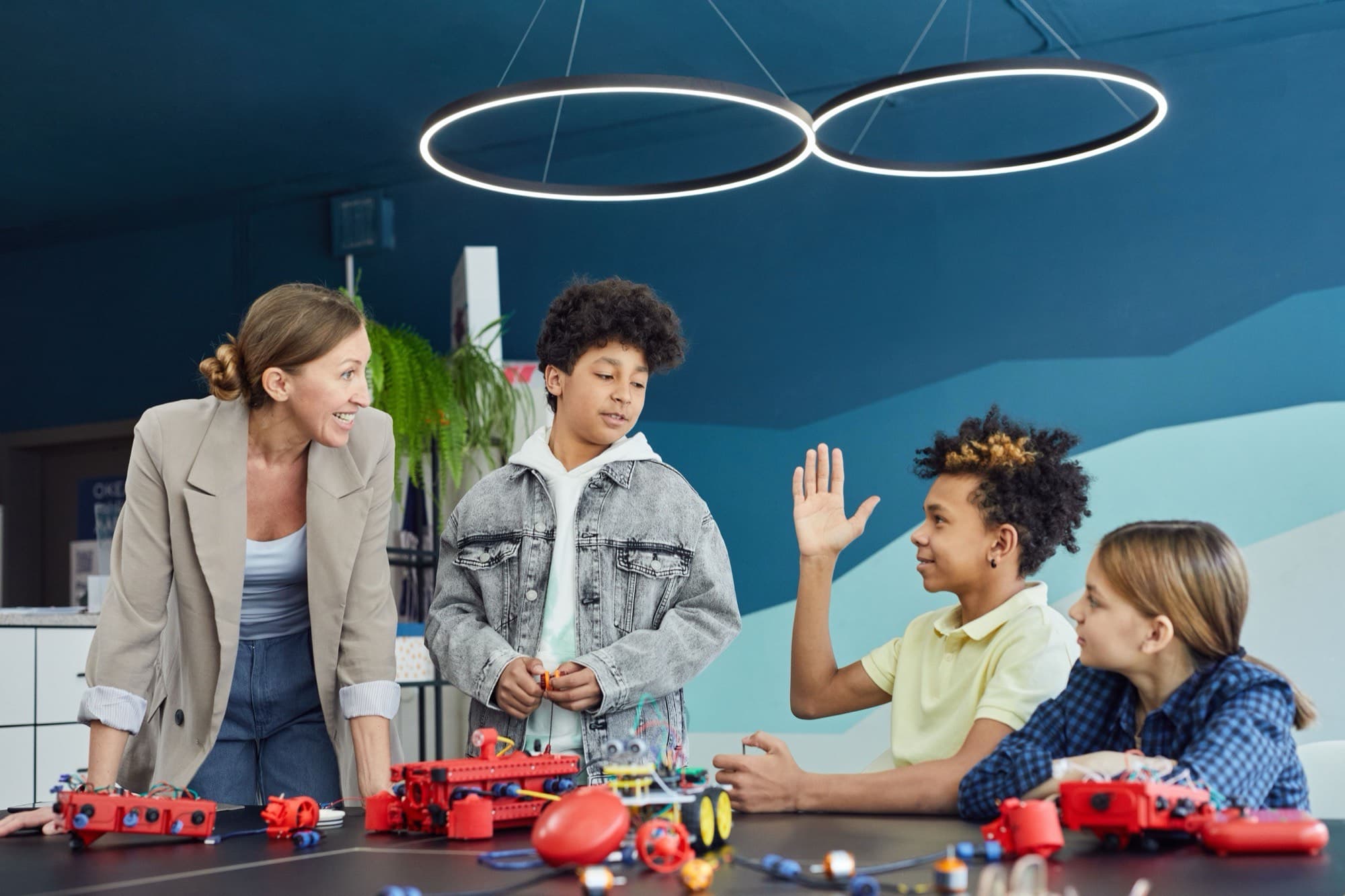
The skills people need keep shifting under every career, and curiosity and lifelong learning are rising in importance. We build programmes that follow a learner through school, university entry, languages and working life, and we are expanding the technology field so learners of every age can build fluency in AI, code and data.
The evidence behind it
Skills keep shifting
Workers can expect 39% of their existing skill sets to be transformed or outdated over 2025 to 2030, 59 of every 100 workers will need training by 2030, and curiosity and lifelong learning are rising in importance.
What we build
- We write and maintain every programme centrally, so a learner meets the same clear programme in every country where we teach.
- We teach AI at three levels, from first principles to advanced practice, alongside programming, data science, robotics and coding for children.
- We publish every programme openly on this website, arranged by field of study, so anyone can read what it offers.
Future skills programmes
- Basic AI
- Intermediate AI
- Advanced AI
- Python Fundamentals
- Data Science Fundamentals
- Robotics
- Kids Coding
What it means
- For learners
- A programme for the next stage of life, whether that is a first exam, a new language or a new career.
- For educators
- A shared curriculum to teach from, so preparation time goes into the learner.
Learning Everywhere
Personal learning in every place people learn: at home, online, in schools, in companies and in learning venues.
Learning happens when the right educator, the right learner and the right place meet. As the education enabler, we connect our educators and learners with the schools, companies, course partners, local partners and learning venues who want great learning for their people and their places. Each partner brings what it knows best, and the network brings the method, the educator standard and the shared technology, so a lesson in a classroom, an office or a coworking room keeps the same standard as a lesson at home.
The evidence behind it
Mastery and teachers
PISA 2025 says education systems need to “favour depth over breadth” for genuine mastery, that “teachers are central to making education systems perform well”, and that AI should be used “in a targeted way for feedback and personalised practice”.
- Educators: teach every class to one standard
- Learners: children, teenagers and adults with a personal plan
- Schools: partner with the network for classes and enrichment
- Companies: train their teams through corporate programmes
- Course partners: bring courses and content onto the shared curriculum
- Local partners: run the network in their own community
- Learning venues: host classes in coworking spaces, study rooms and centres
Who we enable
Schools and universities
Educators, programmes and the method in their own classrooms, for enrichment, exam preparation, languages and future skills such as AI, coding and robotics, with progress the school can see.
Companies and corporate training
Training for their people built with the same method: an assessment of where each person starts, a plan, the right educator and measured progress, in languages, professional skills and future skills.
Course and content partners
A network of educators and learners for their programmes, and a teaching method and quality standard to teach their content with.
Local partners and operators
The method, the curriculum, the educator standard, the shared technology and the brand and quality system, so a local operation teaches to the same standard as every other.
Learning venues
Coworking spaces, learning spaces and venue providers welcome a steady community of learners and educators who come to learn in their rooms.
How it holds together
- One application to teach with us opens teaching at home, online, in partner schools, in companies and in learning venues across the network.
- Schools, companies and local operations work from the same learning plans and progress reports as every other class, as we extend our shared technology across the network.
What it means
- For partners
- Great educators, a clear method and progress they can see, brought to their people and their places.
- For learners
- The same personal plan and the same standard wherever they learn: at home, at school, at work or in a learning space nearby.
Open Doors
Bringing this standard of personal learning to new countries and communities.
The world needs many more teachers, and great teaching should reach more learners in more places. Through Open Doors we bring the method, the curriculum, the educator standard and the shared technology to new countries, working with local operations that know their communities.
The evidence behind it
The teacher gap
UNESCO reports that the world needs 44 million more primary and secondary teachers by 2030, and that primary teacher attrition almost doubled, from 4.62% in 2015 to 9.06% in 2022.
How the network grows
- We partner with local operations that run the network in their country, and each one receives the method, the curriculum and the standards from the start.
- We extend the network’s shared technology to each operation that joins, step by step.
- Local partners bring what only they hold: knowledge of their community and language, local teams and the learners they serve.
- We grow country by country, so every new operation teaches to the standard the network already keeps.
Where the network teaches today
Every country here joined through a local operation that teaches to the same standard.
- Indonesia
- Singapore
- Malaysia
- Philippines
- Thailand
- India
- United Arab Emirates
- Saudi Arabia
- Qatar
- Egypt
- Kenya
- and more, 20+ countries in all
What it means
- For learners
- A personal plan and a trained educator in places where both were hard to find.
- For partners
- A clear method, a teaching standard and a global network behind their work from the first day.
Learning Science and Research
The evidence we build on
Eleven findings shape how we teach and what we build. Each one belongs to the study that produced it, links to its source so anyone can read it in full, and names the commitments it stands behind. Words in quotation marks are the source's own.
Filter the evidence by theme
Showing 11 of 11 findings.
- 01
Learning is falling
Across OECD countries, reading scores fell 28 points and mathematics 22 points between 2015 and 2025, and 20% of 15-year-olds are now low performers in all three PISA subjects, up from 16% in 2022.
The trend varies by country.
- 02
Education stays human
The PISA 2025 foreword sets out a condition: if we get this right, AI becomes “a scaffold” and “a tool for thinking”, and education remains “a human endeavour, powered by judgment, relationships and trust”.
- 03
Mastery and teachers
PISA 2025 says education systems need to “favour depth over breadth” for genuine mastery, that “teachers are central to making education systems perform well”, and that AI should be used “in a targeted way for feedback and personalised practice”.
Behind01 Personal Learning at Scale03 Learning Science and Research05 Learning Everywhere
- 04
Teachers and AI together
The OECD frames three paths for teachers and AI (replacement, complementarity and augmentation) and calls augmentation, where “teachers and AI work in tandem”, “the most effective approach”.
A conceptual framework from the OECD.
Behind02 Teachers, Amplified
- 05
Unguided AI can backfire
In a field experiment with about 1,000 high-school mathematics students, open access to a general AI chat assistant raised practice scores by 48% and lowered later exam grades by 17% once access was removed. A tutor version with teacher-designed hints meant the harm was “largely mitigated”.
The 17% drop applies to the general version only.
- 06
AI that equips tutors
In a randomised trial with 900 tutors and 1,800 K-12 students from under-served communities, students whose tutors had AI guidance were 4 percentage points more likely to master topics, and 9 points more likely with lower-rated tutors, at about USD 20 per tutor per year. Tutors asked more guiding questions and gave away fewer answers.
A working paper awaiting peer review.
Behind02 Teachers, Amplified
- 07
Trained tutors lead
A meta-analysis of randomised tutoring experiments finds a pooled effect of 0.37 standard deviations, with stronger effects for teacher and paraprofessional tutors than for volunteer and parent tutors.
- 08
A human alongside
After five years of post-pandemic research, “human-delivered tutoring has the strongest evidence base”, and students appear to use AI tutors more effectively “when a human is alongside to provide emotional and pedagogical support”.
Behind02 Teachers, Amplified
- 09
Teacher-guided AI
In a six-week randomised programme in Edo State, Nigeria, students used an AI assistant with teacher support and gained 0.31 standard deviations overall and 0.23 standard deviations in English.
- 10
The teacher gap
UNESCO reports that the world needs 44 million more primary and secondary teachers by 2030, and that primary teacher attrition almost doubled, from 4.62% in 2015 to 9.06% in 2022.
Behind06 Open Doors
- 11
Skills keep shifting
Workers can expect 39% of their existing skill sets to be transformed or outdated over 2025 to 2030, 59 of every 100 workers will need training by 2030, and curiosity and lifelong learning are rising in importance.
These results come from the studies named here. They describe what research has found about teaching, tutoring and AI, and they stand apart from the figures that describe our network.
Build the future of learning with us
Educators, partners of every kind and people who want to build with us each have a way in. Choose yours.
Educators
Teach at your best, with a plan, a brief and a report prepared around every lesson.
Teach with usPartners
Schools, universities, companies, course partners, local partners and learning venues: bring great educators and personal learning to your people and your places.
Partner with usCareers
Build the method, the standards and the technology behind every class.
Work at Eduspine
Writing about the future of learning? Visit the press page.